What to do with scrap dental gold: a guide for UK practices
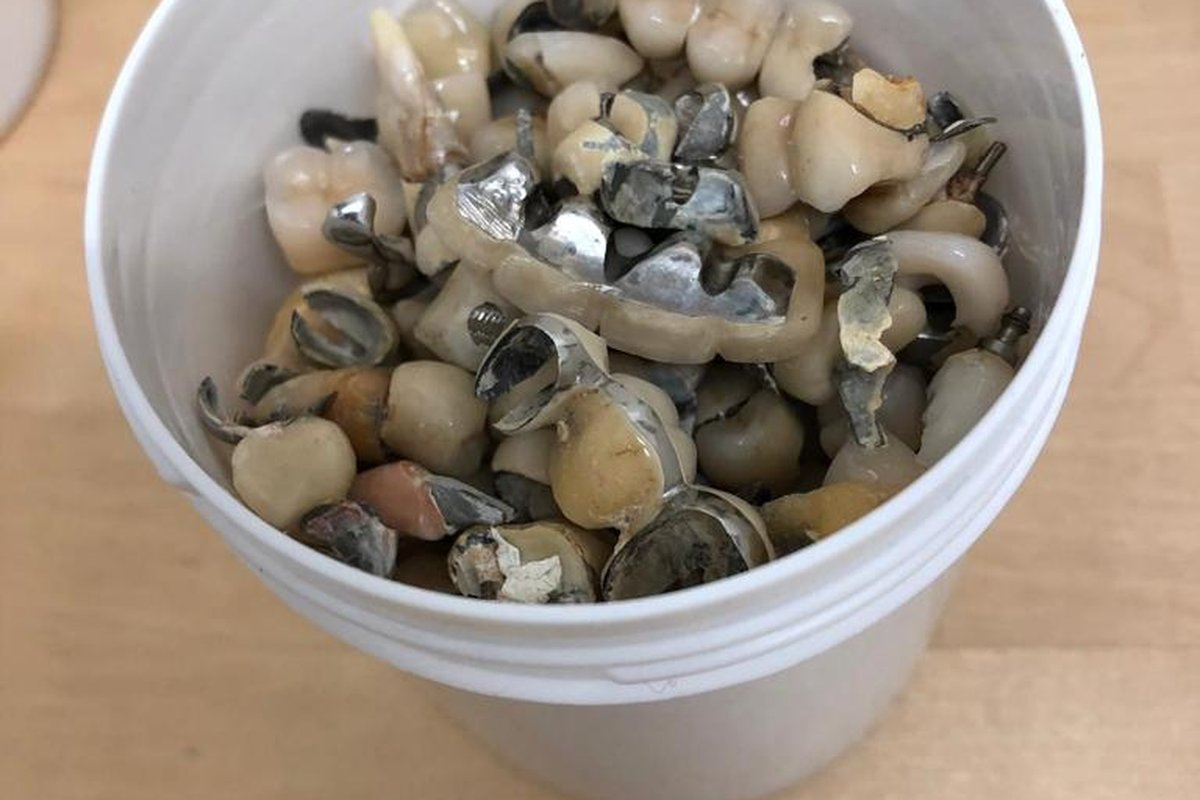
Most dental practices have one somewhere. A little pot in the decon room, a tub at the back of a drawer, or an envelope that's been "meaning to go somewhere" for about three years. It's full of old crowns, bits of bridgework and the occasional inlay, and nobody is quite sure whose job it is.
It's worth sorting out, because that pot usually has real value in it, and there's a very simple way to make it do some good.
What counts as dental scrap?
Dental scrap is any removed restoration that contains precious or semi-precious metal. That usually means:
gold crowns and onlays
inlays
bridges and bridgework
porcelain-fused-to-metal (PFM) and porcelain-fused-to-gold (PFG) restorations
posts and other metal work
The alloys used in dentistry vary, and most contain a mix of gold with platinum, palladium or silver, which all have value once they're refined. Many patients also have old or broken jewellery they no longer want, like odd earrings, snapped chains and single cufflinks, and that can go in the same collection.
Your options
Broadly, there are four things a practice can do with scrap dental gold.
1. Leave it in the drawer. This is the most popular option by a distance, and it does nothing for anyone.
2. Give it back to the patient. A removed restoration is generally treated as the patient's, so offering it back is the right starting point. Some patients do want it, and plenty don't.
3. Sell it to a refiner or dealer. Lots of companies buy dental scrap, and it's a legitimate route. The question worth asking is whose money it is, particularly if patients were never asked what they wanted to happen to their old crowns.
4. Donate it. Collect it, send it to a charity like Gold for Kids, and let it be melted down and turned into grants for UK children's charities.
Ask the patient, it takes ten seconds
The simplest habit to build is a single question when a restoration comes out: "Would you like to keep this, or would you be happy for us to donate it to a children's charity?"
Practices that do this find most patients are happy to donate, and quite a few are delighted to be asked. Some start bringing in old rings and broken chains from home the next time they visit. It also means the practice never has to wonder whether it's holding on to something that wasn't really theirs to keep.
It's worth writing the question into your normal consent conversation so it happens every time, rather than relying on whoever happens to remember.
How donating to Gold for Kids works
There's nothing to wait for in the post and nothing to organise.
Register your practice and download the digital pack.
Print the labels and stick them on a jar. That's your collection jar.
Collect. Your team drops scrap in as it comes out, along with any jewellery patients want to give.
When it's full, send it. Sterilise the scrap, put it in a sterilisation bag and then a padded envelope, add the packing slip from the pack, and post it to Gold for Kids, c/o LPID, 19 Wimpole Street, London, W1G 8GE.
We melt twice a year, at the end of January and the end of July. For the January 2027 melt, your scrap needs to be with us by Friday 15 January.
Is it worth it for a small practice?
Yes, and a part-filled jar is always worth sending. A single crown isn't going to change the world on its own, but every jar goes into the same melt, and it all adds up. Our July 2026 melt raised £17,000, almost entirely from practices sending a few grams at a time.
The practices that keep it going aren't necessarily the biggest. They're the ones where one person on the team decides it matters, whether that's the receptionist who mentions it to patients or the nurse who makes sure the crown goes in the jar and not the bin.
Where does the money go?
Gold for Kids is a registered charity (1190301), and it's one hundred per cent volunteer led and run, with nobody drawing a salary from donations. In line with sustainable practice, we hold back a small percentage of each melt to cover the cost of running the charity and reaching more practices. Everything else goes out in grants to UK charities supporting children in poverty, hardship or crisis, and we publish who received what after every round.
Quick answers
Does it cost the practice anything? Only the cost of posting the jar to us.
Is there a minimum amount? No. Send what you have.
Can we include jewellery? Yes, as long as it's been given freely by the owner.
Can we choose which charity it goes to? Not directly. Our grant committee decides, and we tell you exactly where it went.
If there's a pot in a drawer at your practice right now, this is a good week to deal with it.
Register your practice or, if you're already collecting, here's how to send your scrap.
The Gold for Kids Team