How to set up a scrap gold collection jar in your practice (in ten minutes)
Most practice collection jars don't fail because nobody cares. They fail because nobody's quite sure where the jar is, so the crown that comes out at quarter to five on a Thursday goes in whichever bin happens to be nearest.
Setting one up properly takes about ten minutes, and most of that time goes on deciding where it should live. Here's how to do it.
Minutes one to three: register your practice
Head to goldforkids.org/register, add a few details about your practice, and download the digital pack. There's nothing to wait for in the post, because everything you need is in the pack.
Minutes four and five: find a jar
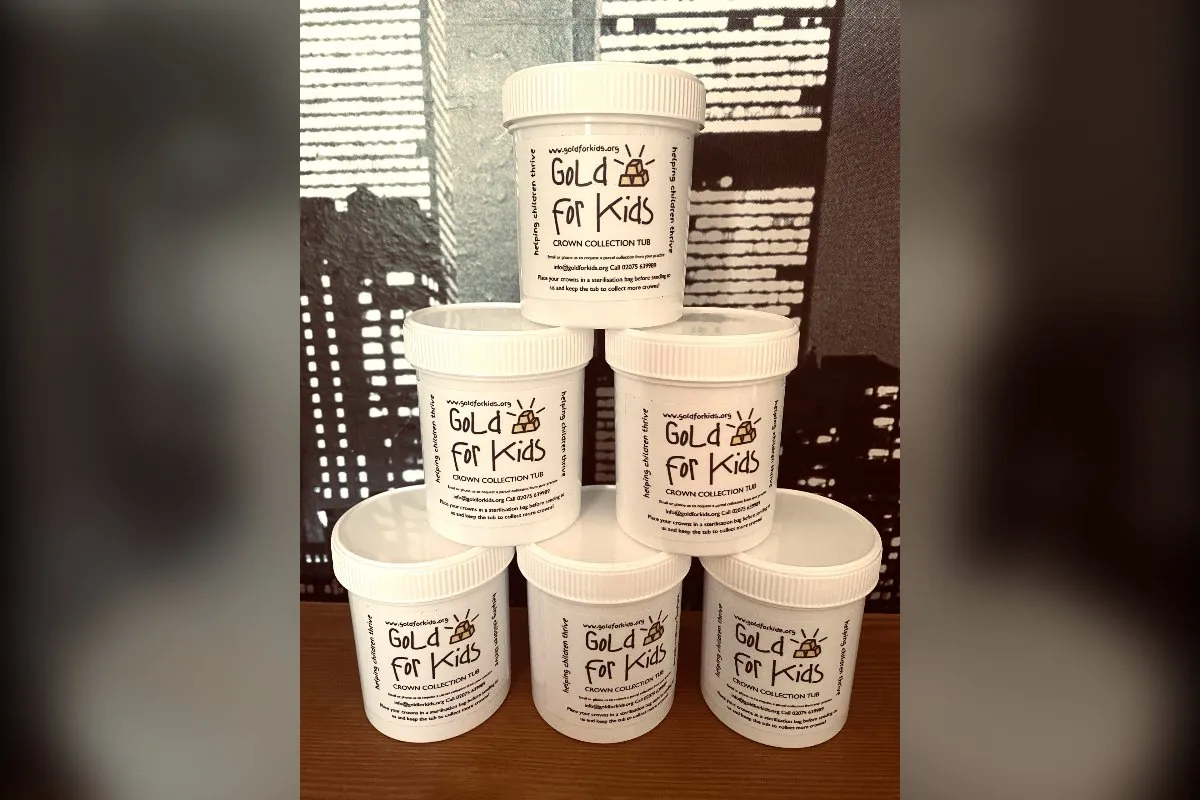
It doesn't need to be anything special. A clean jar with a lid that screws on properly is ideal, and a plastic one is kinder than glass in a busy room. It just needs to be small enough to sit on a worktop without getting in anyone's way, and big enough that it won't be full by Friday.
Minutes six and seven: print and stick on the label
Print the labels from the digital pack and stick one on the jar, facing outwards. The label does two jobs. It tells anyone who picks the jar up what it's for, and it stops it being mistaken for something to clear away. It's worth printing a spare and keeping it with the pack, because labels have a way of getting wet.
Minutes eight and nine: put it where the scrap actually ends up
For most practices that's the decon room, because it's where everything from the surgeries ends up anyway. If you've got several surgeries, one jar in decon usually works better than one in each surgery, because one jar gets emptied and four jars get forgotten.
Treat anything going into the jar as you would any other used item from the surgery, and follow your usual infection control process. When it's time to send the jar, everything gets sterilised before it goes in the post, and we'll walk through that step by step in our next guide.
Minute ten: tell the team, and give one person the job
This is the bit that makes the difference. The practices that keep collecting year after year aren't necessarily the biggest. They're the ones where one person has decided the jar is theirs.
That might be a nurse, the decon lead, the practice manager or someone on reception. Their job isn't to do all the collecting. It's to keep an eye on the jar, give the odd reminder, and send it off when it's full or when a deadline is coming up. Once someone owns it, it quickly becomes part of how the practice works, and after that it needs very little keeping up.
Then let the rest of the team know it's there, ideally at your next huddle or team meeting, so nobody has to guess.
What goes in the jar
gold crowns and onlays
inlays
bridges and bridgework
porcelain-fused-to-metal (PFM) and porcelain-fused-to-gold (PFG) restorations
posts and other metal work
old or broken jewellery that patients have chosen to give, like odd earrings and snapped chains
What doesn't go in: amalgam. It has its own waste route through your amalgam waste contractor, so keep it well away from the jar. If you're not sure whether something belongs, drop us a line at [email protected] before it goes in.
Two habits that keep it going
Ask the patient. When a restoration comes out, one simple question does the job: "Would you like to keep this, or would you be happy for us to donate it to a children's charity?" Most patients are happy to donate, and quite a few are delighted to be asked. It's worth adding the question to your normal consent conversation, so it happens every time rather than whenever someone remembers.
Put the dates somewhere you'll see them. We melt twice a year, at the end of January and the end of July. For the January 2027 melt, your scrap needs to be with us by Friday 15 January. A note on the staff noticeboard, or a reminder in the diary before the Christmas break, saves a scramble in the new year.
When it's full (or nearly)
You don't need to wait for it to be full. A part-filled jar is always worth sending, and every jar goes into the same melt. Our July 2026 melt raised £17,000, almost entirely from practices sending a few grams at a time.
When you're ready to send, everything you need is on our ready to send page.
And if there's a tub of old crowns sitting at the back of a drawer right now, that's your first donation already sorted.
Register your practice or, if you're already collecting, here's how to send your scrap.
The Gold for Kids Team